
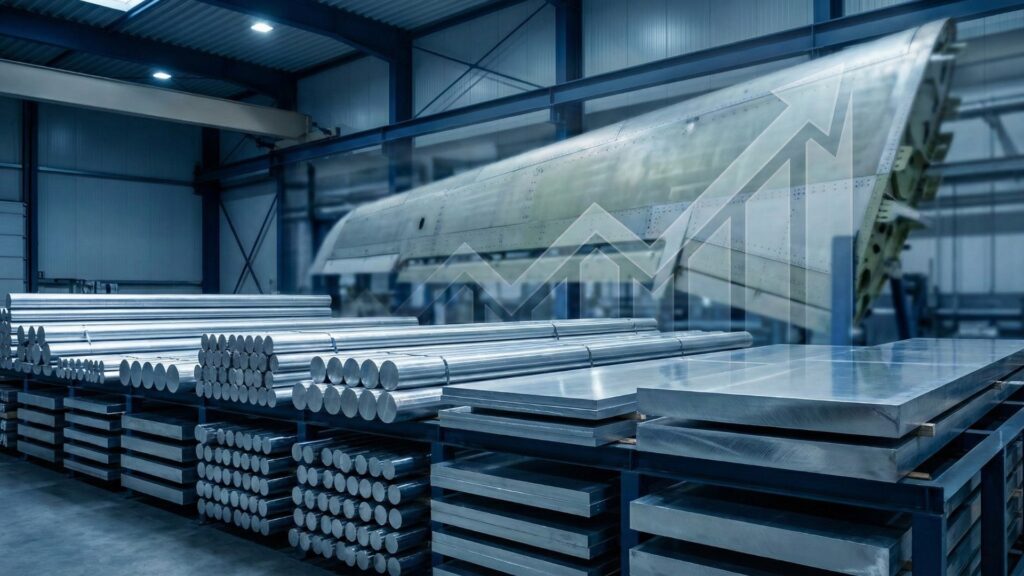
For procurement managers, engineers, and machine shops, 7075-T6 is the go-to alloy for high-strength, low-weight applications. With a new wave of demand forecasted to tighten the market, strategic buyers in critical sectors must focus on developing resilient sourcing and supply chain security to mitigate any potential disruption.
This analysis breaks down the market drivers, technical properties, and sourcing considerations required to navigate the coming decade.
7075-T6 Is Entering a Growth Decade
The market for 7075-T6 aluminum is poised for significant expansion. New analysis from Future Market Insights (FMI) projects this global market will nearly double, growing from $11.8 billion in 2025 to $22.2 billion by 2035. This represents a compound annual growth rate (CAGR) of approximately 6.5%, signaling significant business expansion and a promising future for the industry.
This data is corroborated by other leading market reports from firms such as Global Market Insights and ResearchAndMarkets, which also project a long-term CAGR of 6.5% through 2034. This indicates that the 7075-T6 market is expected to grow steadily, doubling in value by 2035.
This demand isn’t speculative; it’s rooted in the alloy’s unparalleled performance in critical applications. As industries ranging from aerospace to transportation push the boundaries of efficiency and performance, 7075-T6 aluminum is the material specified to make it possible.
Aerospace, Defense, Marine, and Transport Driving Demand
The 6.5% CAGR isn’t materializing out of thin air. It’s being driven by fundamental technological shifts across a few key sectors that rely on the alloy’s specific properties. These shifts include fleet modernization, the push for vehicle lightweighting to meet new emissions and efficiency targets, and the reshoring of critical manufacturing supply chains.
Aerospace & Defense Modernization
This sector remains the primary consumer of 7075 aluminum.
- Airframe Structures: Both commercial and military aircraft rely on aerospace-grade 7075 aluminum for major structural components, such as wing spars, fuselage stringers, and bulkheads, where the strength-to-weight ratio is the single most important metric.
- New Platforms: The development of next-generation fighter jets, drones (UAVs), and commercial space-launch vehicles all specify 7075-T6 for its fatigue resistance and high performance.
- Fleet Upgrades: Modernization programs for existing aircraft fleets also drive sustained demand for replacement and MRO (Maintenance, Repair, and Overhaul) components.
Transportation & Marine Lightweighting
- High-Performance Automotive: Motorsport and high-performance “supercar” manufacturers use 7075-T6 for chassis components, suspension arms, and other parts where shedding every ounce of weight counts without compromising strength.
- Electric Vehicles (EVs): While 6000-series alloys are common in EVs, 7075-T6 is increasingly used in high-load areas like suspension nodes and battery-pack protection structures.
- Marine Equipment: The alloy’s good corrosion resistance (especially in T7x tempers) makes it ideal for high-stress marine applications like high-performance boat hulls, masts, and rigging hardware.
Industrial Automation and Reshoring
A secondary but growing driver is high-end industrial automation. Robotics arms, high-speed pick-and-place machinery, and complex molding tools use 7075-T6 components to provide rigidity and fatigue resistance at high operating speeds.
Furthermore, a strategic shift toward reshoring and supply chain security is driving more OEMs to qualify domestic suppliers, thereby increasing demand for certified materials in North America. This shift could lead to increased competition among suppliers and potentially higher prices, but it also presents an opportunity for local suppliers to expand their market share.
7075-T6 Properties That Win Specs
What makes 7075-T6 the material of choice? It’s not just one property, but the combination. Its ultimate tensile strength is comparable to that of many common steels, but at nearly one-third the weight.
- Superior Strength-to-Weight: This is its primary advantage. The 7075 alloy, in the T6 temper, achieves an ultimate tensile strength often exceeding 80,000 psi (570 MPa). This allows engineers to design parts that are lighter, faster, and more fuel-efficient.
- Excellent Fatigue Performance: In applications with cyclical loading—like aircraft wings or vehicle suspension—fatigue resistance is critical. 7075-T6 maintains its integrity over millions of cycles, ensuring long-term structural reliability.
- Good Corrosion Resistance: While not as corrosion-resistant as 5000-series marine alloys, 7075 offers good stress-corrosion cracking (SCC) resistance, especially in the T73 and T7351 over-aged tempers.
Table: Understanding 7075 Tempers (T6 vs. T651 vs. T7351)
For procurement staff, specifying the correct temper is as important as the alloy itself. The “T” designation refers to the heat-treatment process, which dictates the final mechanical properties.
Temper | Description & Purpose | Stress Relief | Typical Uses |
T6 | Solution heat-treated & artificially aged. | None. | High-strength applications where distortion from machining is not a primary concern. |
T651 | Solution heat-treated, stress-relieved by stretching, then artificially aged. | Yes (Stretched). | Industry standard for plate. Reduces internal stress to provide excellent dimensional stability during heavy machining. Prevents “movement” after material removal. |
T7351 | Solution heat-treated, stress-relieved by stretching, then over-aged (stabilized). | Yes (Stretched). | Provides the highest resistance to stress-corrosion cracking (SCC) and is often specified for critical aerospace or marine parts. Has slightly lower tensile strength than T6/T651. |
Strategic Sourcing Considerations for 7075-T6
As demand tightens, securing a consistent supply of quality material is paramount. Price is only one factor; for critical materials like 7075-T6, supply chain integrity is paramount. Using a sub-par supplier can lead to production delays, failed parts, and catastrophic liability.
When sourcing 7075 aluminum plate or bar, material users should vet potential suppliers against these criteria:
- Full Certification and Traceability
This is non-negotiable. The supplier must provide complete, legible Mill Test Reports (MTRs) for every piece of material. - Precision Cut-to-Size Capabilities
A high-quality aluminum plate distributor will invest in advanced, precision-sawing equipment. This allows them to deliver near-net-shape blocks, plates, or bars cut to exact specifications with tight tolerances, which saves the buyer raw material costs, freight, and valuable machining time. - Deep, On-Hand Inventory
In a tightening market, partnering with a supplier who maintains a substantial, on-hand inventory of 7075 aluminum plate and 7075 aluminum bar in a wide range of common thicknesses and diameters is a critical risk mitigation strategy. - Logistics and Lead Times
The efficiency of the supplier’s quote process, processing, and shipping network is key to meeting production deadlines. A robust, streamlined logistics network is a critical factor for avoiding production bottlenecks.
Applications & Examples
The “7075-T6 applications” list is a “who’s who” of high-performance engineering:
- Aerospace: Wing spars, fuselage frames, missile components, landing gear structures.
- Defense: Structural “backbone” components, high-strength forgings, ordnance.
- Motorsport: Suspension components, wheel centers, chassis structural nodes.
- Marine: High-performance boat hulls, masts, and load-bearing rigging hardware.
- Industrial: High-speed automation components, plastic injection mold tooling, high-stress gears.
Conclusion
The 7075-T6 aluminum market is poised for significant and sustained growth over the next decade, driven by advancements in aerospace, transportation, and industrial automation. For buyers, the challenge will be less about price and more about ensuring a resilient supply chain of fully certified, production-ready material to capitalize on this expanding demand.
Frequently Asked Questions (FAQ)
Is 7075-T6 stronger than 6061-T6?
Yes, significantly. 7075-T6 has a typical ultimate tensile strength over 80,000 psi (570 MPa), which is often double the typical tensile strength of 6061-T6. This superior strength-to-weight ratio is why 7075-T6 is chosen for high-stress, critical applications where failure is not an option.
What’s the difference between T6 and T651?
Both are artificially aged tempers. The “51” in T651 signifies it has been stress-relieved by controlled stretching after heat treatment but before aging. This process minimizes internal stresses, providing superior dimensional stability during and after machining. T651 is the preferred standard for plates and parts that require extensive milling, as it prevents the “warping” that can occur with T6 material.
Can 7075-T6 be welded or anodized effectively?
7075-T6 is generally considered non-weldable by common fusion methods (like TIG or MIG). The heat from welding compromises its high-strength heat treatment and can cause material cracking. It can be anodized; however, it is more challenging than 6000-series alloys and may result in a less uniform cosmetic finish. Hard-coat anodizing for wear resistance and corrosion protection is common and effective.
Which sectors are driving demand through 2035?
According to market analysis from Future Market Insights, the primary drivers are the Aerospace & Defense, Transportation (including automotive and marine), and Industrial Manufacturing sectors. This growth, forecasted at a ~6.5% CAGR to 2035, is fueled by global fleet modernization, the push for lightweighting in vehicles, and advanced industrial automation.